
STIOLTO RESPIMAT has proven efficacy in patients with symptomatic COPD1

Onset and Duration of Bronchodilation1
STIOLTO RESPIMAT offers

In clinical trials, STIOLTO RESPIMAT demonstrated bronchodilation within 5 minutes after the first dose, with FEV1 response maintained over the full 24-hour dosing interval.1*
*STIOLTO RESPIMAT is NOT a rescue medication and does NOT replace fast-acting inhalers to treat acute symptoms.
Trials 1 and 2 evaluated lung function as the primary endpoint. The St. George’s Respiratory Questionnaire (SGRQ) was assessed in Trials 1 and 2 and in two additional 12-week placebo-controlled trials (Trials 3 and 4). Separate trials evaluated exacerbations.
Helps Prevent Exacerbations
STIOLTO RESPIMAT — proven to help prevent exacerbations1-3
31% reduction in risk of exacerbations with tiotropium compared with placebo1,2
Tiotropium, an active ingredient of STIOLTO RESPIMAT, reduced the risk of exacerbations by 31% (RR=0.69 [95% CI: 0.63, 0.77]; P<0.0001) vs placebo.

27% reduction in risk of exacerbation-related hospitalizations vs placebo, independent of ICS use1,2
Tiotropium, an active ingredient of STIOLTO RESPIMAT, reduced the risk of exacerbation-related hospitalizations, independent of ICS use, by 27% vs placebo (RR=0.73 [95% CI: 0.589, 0.901]; P=0.0191).
ICS, inhaled corticosteroid.

7% reduction in annualized rate of moderate and severe exacerbations compared with SPIRIVA RESPIMAT3
STIOLTO RESPIMAT reduced the annualized rate of moderate and severe exacerbations vs tiotropium bromide by 7% (RR=0.93 [99% CI: 0.85, 1.02]; P=0.049). The P value of 0.049 did not meet the prespecified significance level of 0.01.

Lung Function Improvement (FEV1)1
STIOLTO RESPIMAT vs Monotherapy
In two 52-week confirmatory trials, STIOLTO RESPIMAT demonstrated significant improvements in lung function after 24 weeks compared with tiotropium 5 mcg and olodaterol 5 mcg (P≤0.0001 for all comparisons).
STIOLTO RESPIMAT displayed a mean increase in FEV1 from baseline of 0.137 L (range: 0.133-0.140 L) within 5 minutes after the first dose. Patients treated with STIOLTO RESPIMAT used less rescue medication compared to patients treated with tiotropium 5 mcg and olodaterol 5 mcg.
FEV1 AUC0-3hr and Trough FEV1 response for STIOLTO RESPIMAT compared to tiotropium 5 mcg and olodaterol 5 mcg after 24 weeks (primary endpoints; Trials 1 and 2)
Trial 1 | Trial 2 | |||||
n | Mean, L | Difference, L (95% CI) | n | Mean, L | Difference, L (95% CI) | |
FEV1 AUC0-3hr response |
|
|
|
|
|
|
STIOLTO RESPIMAT | 522 | 0.256 | - | 502 | 0.268 | - |
Tiotropium 5 mcg | 526 | 0.139 | 0.117 (0.094, 0.140) | 500 | 0.165 | 0.103 (0.078, 0.127) |
Olodaterol 5 mcg | 525 | 0.133 | 0.123 (0.100, 0.146) | 507 | 0.136 | 0.132 (0.108, 0.157) |
Trough FEV1 response |
|
|
|
|
|
|
STIOLTO RESPIMAT | 521 | 0.136 | - | 497 | 0.145 | - |
Tiotropium 5 mcg | 520 | 0.065 | 0.071 (0.047, 0.094) | 498 | 0.096 | 0.050 (0.024, 0.075) |
Olodaterol 5 mcg | 519 | 0.054 | 0.082 (0.059, 0.106) | 503 | 0.057 | 0.088 (0.063, 0.113) |
Pre-treatment baseline FEV1: Trial 1 = 1.16 L; Trial 2 = 1.15 L.
P≤0.0001 for all comparisons between STIOLTO RESPIMAT and the monotherapies.
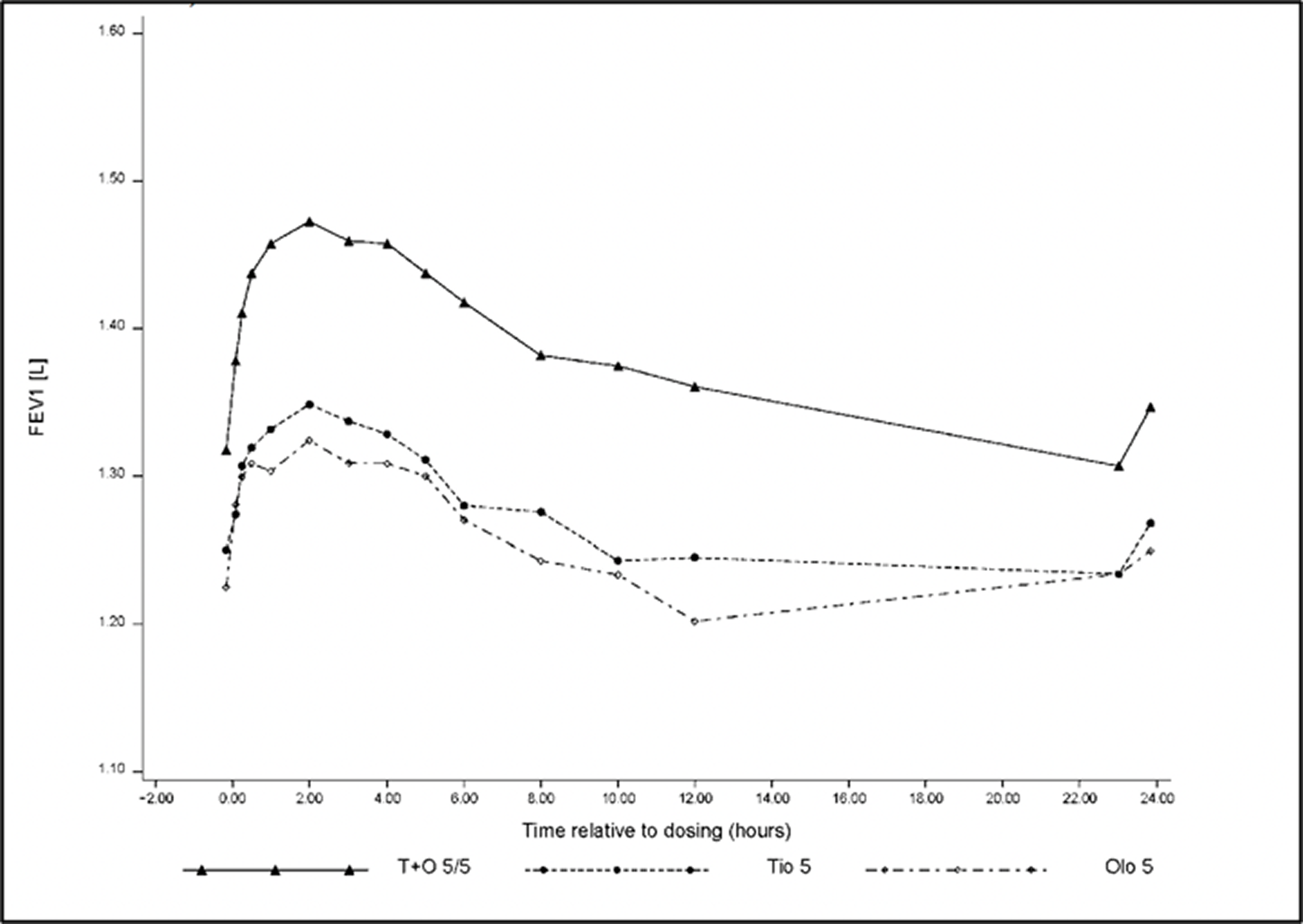
For the subset of patients (n=521) who completed extended lung function measurement up to 12 hours post-dose, STIOLTO RESPIMAT showed a significantly greater FEV1 response compared to tiotropium 5 mcg and olodaterol 5 mcg over the full 24-hour dosing interval.
FEV1 profile for STIOLTO RESPIMAT, tiotropium 5 mcg and olodaterol 5 mcg over a 24-hour dosing interval after 24 weeks (12 hr PFT subset from Trial 2)
Study Designs
Expand allA 52-week, double-blind, parallel-group trial that included patients with COPD and a history of exacerbations who were randomized 1:1 using a randomized block design to receive STIOLTO RESPIMAT 5 mcg-5 mcg or SPIRIVA® RESPIMAT® (tiotropium bromide) Inhalation Spray 5 mcg once daily. The primary endpoint was the rate of moderate and severe COPD exacerbations, at a significance level of 0.01. A total of 7903 patients were randomized in the study and 7880 were treated; 3939 received STIOLTO RESPIMAT and 3941 received SPIRIVA RESPIMAT.3
Two 52-week, replicate, randomized, double-blind, active-controlled, parallel-group trials (TONADO 1 and 2) evaluated STIOLTO RESPIMAT 5 mcg/5 mcg versus tiotropium 5 mcg and olodaterol 5 mcg in 5162 patients with COPD (1,029 receiving STIOLTO RESPIMAT, 1,038 receiving olodaterol 5 mcg, and 1,033 receiving tiotropium bromide 5 mcg). All treatments were administered once daily in the morning via the RESPIMAT inhaler. The primary endpoints were change from baseline in FEV₁ AUC₀₋₃ₕᵣ and trough FEV₁ after 24 weeks of treatment. Major inclusion criteria included patients ≥40 years of age with a clinical diagnosis of COPD, a smoking history of >10 pack-years, and moderate to very severe airflow limitation (post-bronchodilator FEV₁ <80% predicted normal [GOLD 2–4]; post-bronchodilator FEV₁/FVC <70%).1
In a 1-year, randomized, double-blind, parallel-group study, 3991 patients with COPD were evaluated to compare tiotropium via RESPIMAT and placebo (n=1939 tiotropium and n=1953 placebo were evaluable for efficacy) coprimary endpoints: change in trough FEV₁ from treatment Day 1 to Day 337, and time to first COPD exacerbation. Secondary endpoints were changes in trough FEV₁ at Days 29 and 169 and in trough FVC at Days 29, 169, and 337, the number of exacerbations per patient, the number of patients with ≥1 exacerbation, and the time to first exacerbation-related hospitalization. Exacerbations were defined as a complex of respiratory events or symptoms that lasted ≥3 days and required treatment with antibiotics and/or systemic corticosteroids, or prompted the investigator to change the patient's regular respiratory medication.2
The majority of patients in both treatment groups were on concomitant maintenance medication. All respiratory medications except inhaled anticholinergics were permitted.
Major inclusion criteria included patients with a diagnosis of COPD, 40 years of age or over, a prebronchodilator FEV₁ of ≤60% of predicted normal and a ratio of FEV₁ to FVC of ≤70%, and a smoking history of 10 pack-years or more.
FEV₁, forced expiratory volume in 1 second; FVC, forced vital capacity.
The St. George's Respiratory Questionnaire (SGRQ) is a validated instrument that measures health-related quality of life across three domains4:
Symptoms: Frequency and severity of respiratory symptoms
Activity: Physical activities limited by breathlessness
Impact: Social and psychological effects of the disease
A decrease of ≥4 points on the SGRQ total score is considered a clinically meaningful improvement.
Health-Related Quality of Life
STIOLTO RESPIMAT: Demonstrated improvement in health-related quality of life vs tiotropium bromide and placebo as measured by St. Georges Respiratory Questionnaire (SGRQ) responder analysis.1,5,6
SGRQ questionnaire includes the domains of time without symptoms, activity, and social impact. The SGRQ consists of 16 questions about patients’ recollection of their symptoms over the past month and their current state including activity levels and impact on functioning.
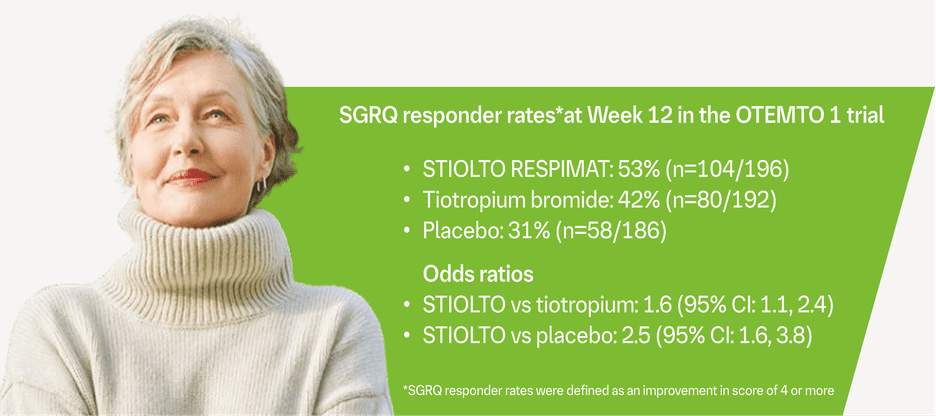
Similar results were confirmed in a replicate trial (OTEMTO 2) and in two 52-week trials at Week 24 (TONADO 1 and 2).1
OTEMTO 1 and 2 were double-blind, parallel-group, placebo-controlled trials where patients ≥40 years old with moderate to severe COPD received STIOLTO RESPIMAT 5/5ug or 2.5/5ug, tiotropium bromide 5 ug, or placebo once daily for 12 weeks.6
FAQs
Expand allTiotropium, an active ingredient of STIOLTO RESPIMAT, has been proven to help prevent COPD exacerbations, with a 31% reduction in risk of exacerbations with tiotropium compared with placebo plus a 27% reduction in risk of exacerbation-related hospitalizations - observed in clinical trials.1,2
STIOLTO RESPIMAT significantly improved health-related quality of life on the following parameters:*,1,4,5
Time without symptoms
Activity levels
Social impact
Note:
*In one 12-week trial (OTEMTO® 1), SGRQ responder rates at week 12 (defined as an improvement in score of 4 or more) were 53% (n=104/196), 42% (n=80/192), and 31% (n=58/186) for STIOLTO RESPIMAT, tiotropium bromide, and placebo, respectively, with odds ratios of 1.6 (95% CI: 1.1, 2.4) and 2.5 (95% CI: 1.6, 3.8) for STIOLTO RESPIMAT vs tiotropium bromide and STIOLTO RESPIMAT vs placebo, respectively. Similar results were confirmed in a replicate trial (OTEMTO® 2) and in two 52-week trials at Week 24 (TONADO® 1 and 2)
STIOLTO® RESPIMAT® (tiotropium bromide and olodaterol) Inhalation Spray is a combination of tiotropium, an anticholinergic, and olodaterol, a long-acting beta2-adrenergic agonist (LABA), indicated for the long-term, once-daily maintenance treatment of patients with chronic obstructive pulmonary disease (COPD), including chronic bronchitis and/or emphysema.
Important Limitations of Use
STIOLTO is NOT indicated to treat acute deterioration of COPD and is not indicated to treat asthma.
CONTRAINDICATION
Use of a LABA, including STIOLTO RESPIMAT, without an inhaled corticosteroid (ICS) is contraindicated in patients with asthma.
STIOLTO is contraindicated in patients with hypersensitivity to tiotropium, ipratropium (atropine derivatives), olodaterol, or any component of this product.
In clinical trials and postmarketing experience with tiotropium, immediate hypersensitivity reactions, including angioedema (including swelling of the lips, tongue, or throat), itching, or rash have been reported. Hypersensitivity reactions were also reported in clinical trials with STIOLTO.
WARNINGS AND PRECAUTIONS
LABA as monotherapy (without an ICS), for asthma increases the risk of asthma-related death, and in pediatric and adolescent patients, increases the risk of asthma-related hospitalizations.
Do not initiate STIOLTO in patients with acutely deteriorating COPD, which may be a life-threatening condition, or used as rescue therapy for acute symptoms. Acute symptoms should be treated with an inhaled short-acting beta2-agonist.
STIOLTO should not be used more often or at higher doses than recommended, or with other LABAs as an overdose may result.
If immediate hypersensitivity reactions occur, such as urticaria, angioedema, rash, bronchospasm, anaphylaxis, or itching, discontinue STIOLTO at once and consider alternative treatment. Patients with a history of hypersensitivity reactions to atropine or its derivatives should be closely monitored for similar hypersensitivity reactions to STIOLTO.
If paradoxical bronchospasm occurs, discontinue STIOLTO immediately and institute alternative therapy.
STIOLTO can produce a clinically significant cardiovascular effect in some patients, as measured by increases in pulse rate, systolic or diastolic blood pressure, and/ or symptoms. If such effects occur, STIOLTO may need to be discontinued.
Use caution in patients with convulsive disorders, thyrotoxicosis, diabetes mellitus, ketoacidosis, in patients with known or suspected prolongation of the QT interval, and in patients who are unusually responsive to sympathomimetic amines.
Use with caution in patients with narrow-angle glaucoma. Instruct patients to contact a physician immediately if signs or symptoms of acute narrow-angle glaucoma develop.
Use with caution in patients with urinary retention especially in patients with prostatic hyperplasia or bladder-neck obstruction. Instruct patients to consult a physician immediately should any of these signs or symptoms develop.
Patients with moderate to severe renal impairment (creatinine clearance of <60 mL/min) should be monitored closely for anticholinergic side effects.
Be alert to hypokalemia and hyperglycemia.
ADVERSE REACTIONS
The most common adverse reactions with STIOLTO (>3% incidence and higher than an active control) were: nasopharyngitis, 12.4% (11.7%/12.6%), cough, 3.9% (4.4%/3.0%), and back pain, 3.6% (1.8%/3.4%).
DRUG INTERACTIONS
Use caution if administering adrenergic drugs because sympathetic effects of olodaterol may be potentiated.
Concomitant treatment with xanthine derivatives, steroids, or diuretics may potentiate any hypokalemic effect of olodaterol.
Use with caution in patients taking non–potassium-sparing diuretics, as the ECG changes and/or hypokalemia may worsen with concomitant beta-agonists.
The action of adrenergic agents on the cardiovascular system may be potentiated by monoamine oxidase inhibitors or tricyclic antidepressants or other drugs known to prolong the QTc interval. Therefore, STIOLTO should be used with extreme caution in patients being treated with these drugs. Use beta-blockers with caution as they not only block the therapeutic effects of beta-agonists, but may produce severe bronchospasm in patients with COPD.
Avoid co-administration of STIOLTO with other anticholinergic-containing drugs as this may lead to an increase in anticholinergic adverse effects.
STIOLTO is for oral inhalation only.
The STIOLTO cartridge is only intended for use with the STIOLTO RESPIMAT inhaler.
Inform patients not to spray STIOLTO into the eyes as this may cause blurring of vision and pupil dilation.
CL-STO-100048 6.5.2019
Please see full Prescribing Information, Patient Information, and Instructions for Use for STIOLTO RESPIMAT.
References
-
STIOLTO RESPIMAT [prescribing information]. Ridgefield, CT: Boehringer Ingelheim Pharmaceuticals, Inc; January 2025.
-
Bateman ED, Tashkin D, Siafakas N, et al. A one-year trial of tiotropium Respimat plus usual therapy in COPD patients. Respir Med. 2010;104(10):1460-1472.
-
Calverley PMA, Anzueto AR, Carter K, et al. Tiotropium and olodaterol in the prevention of chronic obstructive pulmonary disease exacerbations (DYNAGITO): a double-blind, randomised, parallel-group, active-controlled trial. Lancet Respir Med. 2018;6(5):337-344.
-
Jones PW, Forde Y. St George's Respiratory Questionnaire Manual. London, UK: St George's, University of London; 2009.
-
Singh D, Ferguson GT, Bolitschek J, et al. Tiotropium + olodaterol shows clinically meaningful improvements in quality of life. Respir Med. 2015;109(10):1312-1319.