
Why are LAMA/LABAs an appropriate choice for many of your patients with symptomatic COPD?

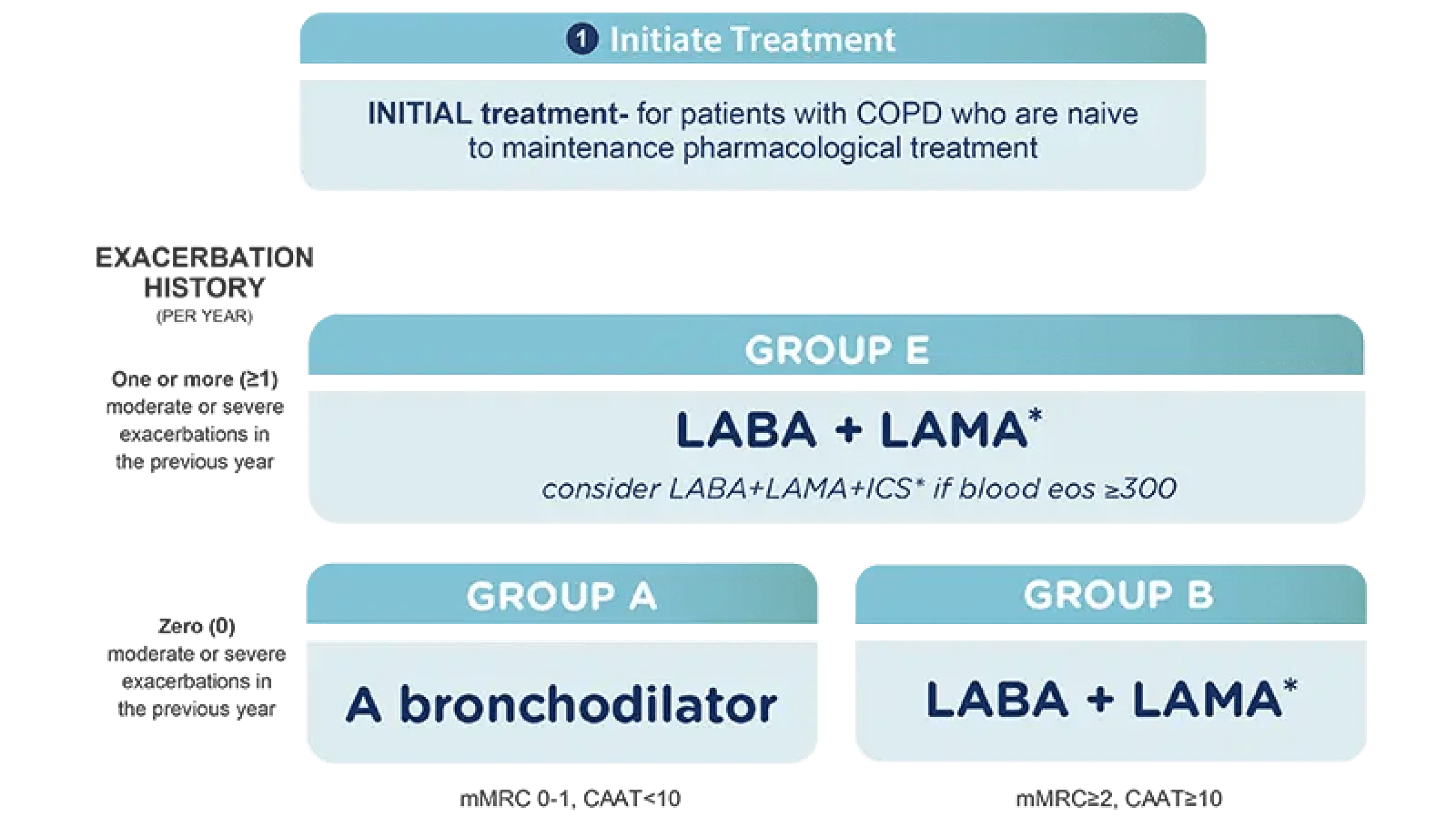
GOLD recommends LABA/LAMA therapy as the preferred way to initiate treatment for patients in both Group B and Group E1
-
*
Single inhaler therapy may be more convenient and effective than multiple inhalers; single inhalers improve adherence to treatment. Exacerbations refers to the number of exacerbations per year; eos: blood eosinophil count in cells per microliter; mMRC: modified Medical Research Council dyspnea questionnaire; CATTM: Chronic Airways Assessment TestTM.
Adapted from © 2025, 2026 Global Initiative for Chronic Obstructive Lung Disease, Inc. Available from www.goldcopd.org.
Learn more about using LAMA/LABA in COPD

Hello, and thank you for joining. In the next two minutes, we'll focus on the key GOLD 2026 highlights related to bronchodilator use in COPD.
GOLD recommendations support the use of LAMA and LABA dual bronchodilation as the preferred way to initiate treatment for patients in both Group B and Group E. Note that in the 2026 GOLD Recommendations, Group B patients are defined as those who had no moderate or severe exacerbations in the previous year and have an mMRC ≥2 and CAAT ≥10.
Group E patients are defined as those who had one or more moderate or severe exacerbations in the previous year.
In 2023, there was a shift in COPD initial treatment to recommend dual long-acting bronchodilation rather than starting with a single long-acting bronchodilator in Group B patients.
GOLD 2026 recommends LAMA/LABA dual bronchodilation as an initial treatment option for appropriate patients in Group B and Group E based on symptom burden and exacerbation risk.
For patients already on bronchodilator monotherapy who remain dyspneic, GOLD recommendations support stepping up to dual bronchodilation.
At the same time, a LABA plus inhaled corticosteroid (ICS) has a more limited role in COPD, and if an ICS is indicated, GOLD recommends triple therapy (LAMA + LABA + ICS) instead of a LABA plus ICS alone.
For group A, treatment still begins with a bronchodilator, chosen based on its effect on breathlessness and continued if benefit is documented. Patients in Group A are defined as those who had no moderate or severe exacerbations in the previous year and have an mMRC of 0 to 1 and CAAT less than 10.
For group B, GOLD recommends starting with LAMA and LABA dual bronchodilation, reflecting changes introduced in the GOLD 2023 initial treatment recommendations.
For group E the recommended initial option is also LAMA and LABA when blood eosinophil counts are less than 300 cells/microliter.
If eosinophil counts are greater than or equal to 300 cells/microliter, triple therapy with LABA, LAMA, and ICS may be considered. Decisions regarding ICS use should take into account exacerbation risk and blood eosinophil count.
Follow-up care is built around a review, assess, and adjust cycle.
When dyspnea persists, start by reassessing the cause. Symptoms may reflect comorbidity, deconditioning, poor inhaler adherence, or another explanation beyond airflow limitation alone.
It's also important to check inhaler technique and confirm that the device matches the patient's abilities, such as inspiratory flow, coordination, and consistent use.
In follow-up treatment, persistent dyspnea generally points toward optimizing bronchodilation, while recurrent exacerbations may prompt consideration of ICS containing triple therapy, depending on blood eosinophil counts.
So, GOLD recommends LAMA/LABA dual bronchodilation as initial pharmacologic treatment for Groups B and E, with ICS-containing triple therapy considered for select patients based on exacerbation risk and blood eosinophil count.
Thank you for your time in this important matter. I hope you found this discussion helpful.
GOLD 2026 — Updated recommendations for initial pharmacological treatment1,2
Expand allThe 2026 GOLD Report reinforces and clarifies the central role of LAMA/LABA combination therapy1
Group B (high symptom burden, mMRC ≥2 or CAAT ≥10, without significant exacerbation history): LAMA/LABA is the recommended initial therapy, rather than a choice between monotherapy and dual therapy reflecting changes introduced in the GOLD 2023 initial treatment recommendations.
Group E (≥1 moderate or severe exacerbation in the past year): Group E now includes patients with even a single moderate/severe exacerbation, reflecting evidence that one exacerbation increases the risk of future events. For these patients, LAMA/LABA is the recommended initial therapy. ICS-containing triple therapy may be considered initially if blood eosinophils are ≥300 cells/μL.
Since the landmark changes in 2023, LABA/ICS is no longer encouraged: GOLD 2026 explicitly states that LABA/ ICS combination therapy is no longer encouraged for COPD. If ICS is indicated, it should be added to a LAMA/ LABA foundation (i.e., triple therapy), not paired with LABA alone.
The clinical significance of a single exacerbation
Exacerbations of COPD are important events that negatively impact health status, contribute to disease progression, and enhance the rate of lung function decline.1
Research has shown that experiencing even one moderate or severe COPD exacerbation increases the risk of subsequent exacerbations approximately 4-fold.2
GOLD's 2026 redefinition of Group E (lowering the threshold from ≥2 to ≥1 moderate/severe exacerbation) reflects this evidence.1,3
Maximizing bronchodilation through two mechanisms1,3
LAMA and LABA agents produce bronchodilation through independent pathways:
LAMAs inhibit M3 muscarinic receptors on airway smooth muscle, blocking cholinergic bronchoconstriction
LABAs activate beta2-adrenoceptors, stimulating intracellular adenyl cyclase to elevate cyclic AMP, which relaxes airway smooth muscle
According to GOLD 2026, combining bronchodilators with different mechanisms and duration of action may increase the degree of bronchodilation compared to increasing the dose of a single bronchodilator.1
GOLD 2026 supports LAMA/LABA dual therapy over either component alone for patients with higher symptom burden (Group B) or exacerbation history (Group E).1
GOLD 2026 includes recommendations regarding inhaler device selection and use in patients with COPD1
GOLD 2026 emphasizes that appropriate device selection requires consideration of multiple patient-specific factors. Poor inhaler technique is common among patients with COPD.
GOLD 2026 also recognizes that simplifying a patient's regimen, for example by using a single inhaler, may support adherence. Where clinically appropriate, this may help reduce treatment complexity and support consistent use.
Current guidelines support patient education on inhaler use1
GOLD 2026 recommends that inhaler technique be regularly assessed and reinforced during patient interactions.
STIOLTO® RESPIMAT® (tiotropium bromide and olodaterol) Inhalation Spray is a combination of tiotropium, an anticholinergic, and olodaterol, a long-acting beta2-adrenergic agonist (LABA), indicated for the long-term, once-daily maintenance treatment of patients with chronic obstructive pulmonary disease (COPD), including chronic bronchitis and/or emphysema.
Important Limitations of Use
STIOLTO is NOT indicated to treat acute deterioration of COPD and is not indicated to treat asthma.
CONTRAINDICATION
Use of a LABA, including STIOLTO RESPIMAT, without an inhaled corticosteroid (ICS) is contraindicated in patients with asthma.
STIOLTO is contraindicated in patients with hypersensitivity to tiotropium, ipratropium (atropine derivatives), olodaterol, or any component of this product.
In clinical trials and postmarketing experience with tiotropium, immediate hypersensitivity reactions, including angioedema (including swelling of the lips, tongue, or throat), itching, or rash have been reported. Hypersensitivity reactions were also reported in clinical trials with STIOLTO.
WARNINGS AND PRECAUTIONS
LABA as monotherapy (without an ICS), for asthma increases the risk of asthma-related death, and in pediatric and adolescent patients, increases the risk of asthma-related hospitalizations.
Do not initiate STIOLTO in patients with acutely deteriorating COPD, which may be a life-threatening condition, or used as rescue therapy for acute symptoms. Acute symptoms should be treated with an inhaled short-acting beta2-agonist.
STIOLTO should not be used more often or at higher doses than recommended, or with other LABAs as an overdose may result.
If immediate hypersensitivity reactions occur, such as urticaria, angioedema, rash, bronchospasm, anaphylaxis, or itching, discontinue STIOLTO at once and consider alternative treatment. Patients with a history of hypersensitivity reactions to atropine or its derivatives should be closely monitored for similar hypersensitivity reactions to STIOLTO.
If paradoxical bronchospasm occurs, discontinue STIOLTO immediately and institute alternative therapy.
STIOLTO can produce a clinically significant cardiovascular effect in some patients, as measured by increases in pulse rate, systolic or diastolic blood pressure, and/ or symptoms. If such effects occur, STIOLTO may need to be discontinued.
Use caution in patients with convulsive disorders, thyrotoxicosis, diabetes mellitus, ketoacidosis, in patients with known or suspected prolongation of the QT interval, and in patients who are unusually responsive to sympathomimetic amines.
Use with caution in patients with narrow-angle glaucoma. Instruct patients to contact a physician immediately if signs or symptoms of acute narrow-angle glaucoma develop.
Use with caution in patients with urinary retention especially in patients with prostatic hyperplasia or bladder-neck obstruction. Instruct patients to consult a physician immediately should any of these signs or symptoms develop.
Patients with moderate to severe renal impairment (creatinine clearance of <60 mL/min) should be monitored closely for anticholinergic side effects.
Be alert to hypokalemia and hyperglycemia.
ADVERSE REACTIONS
The most common adverse reactions with STIOLTO (>3% incidence and higher than an active control) were: nasopharyngitis, 12.4% (11.7%/12.6%), cough, 3.9% (4.4%/3.0%), and back pain, 3.6% (1.8%/3.4%).
DRUG INTERACTIONS
Use caution if administering adrenergic drugs because sympathetic effects of olodaterol may be potentiated.
Concomitant treatment with xanthine derivatives, steroids, or diuretics may potentiate any hypokalemic effect of olodaterol.
Use with caution in patients taking non–potassium-sparing diuretics, as the ECG changes and/or hypokalemia may worsen with concomitant beta-agonists.
The action of adrenergic agents on the cardiovascular system may be potentiated by monoamine oxidase inhibitors or tricyclic antidepressants or other drugs known to prolong the QTc interval. Therefore, STIOLTO should be used with extreme caution in patients being treated with these drugs. Use beta-blockers with caution as they not only block the therapeutic effects of beta-agonists, but may produce severe bronchospasm in patients with COPD.
Avoid co-administration of STIOLTO with other anticholinergic-containing drugs as this may lead to an increase in anticholinergic adverse effects.
STIOLTO is for oral inhalation only.
The STIOLTO cartridge is only intended for use with the STIOLTO RESPIMAT inhaler.
Inform patients not to spray STIOLTO into the eyes as this may cause blurring of vision and pupil dilation.
CL-STO-100048 6.5.2019
Please see full Prescribing Information, Patient Information, and Instructions for Use for STIOLTO RESPIMAT.
Reference
-
Global Initiative for Chronic Obstructive Lung Disease (GOLD). Global strategy for the diagnosis, management, and prevention of chronic obstructive pulmonary disease. Accessed, December 02, 2025. https://goldcopd.org/2026-gold-report.
-
Hurst JR, Vestbo J, Anzueto A, et al. Susceptibility to exacerbation in chronic obstructive pulmonary disease. N Engl J Med. 2010;363(12):1128-1138.
-
Cazzola M and Molimard M. The scientific rationale for combining long-acting β2-agonists and muscarinic antagonists in COPD. Pulm Pharmacol Ther. 2010;23(4):257-267.